

Key Highlights
- A deposit bond is a guarantee issued by an insurer that substitutes for a cash deposit at exchange (you pay a fee, not the deposit itself).
- The typical cost is 1% to 1.5% of the deposit amount for a short-term bond, so on a $60,000 deposit that is $600 to $900.
- The bond does not replace your deposit at settlement as you still need the full funds by the settlement date.
- Most issuers require unconditional finance approval before they will issue a bond. A pre-approval alone is generally not sufficient.
- Not all vendors in Queensland will accept a deposit bond, therefore confirming acceptance before auction is essential.
So what is it?
You have found the property. You have done your research, you know what you are willing to pay, and you are ready to buy. There is just one problem: your deposit is tied up somewhere else. It is sitting in a term deposit that does not mature for another six weeks. It is equity in a property you have not yet sold. It is in the proceeds of a share sale still waiting to clear.
You need $60,000 in cash on the day of auction, or at exchange on a private treaty, and you do not have it sitting liquid in your account right now.
This is the situation deposit bonds were designed for. This guide explains exactly what a deposit bond is, how it works, what it costs, who qualifies, and when it is and is not the right option for buyers in Queensland.
What is a deposit bond?
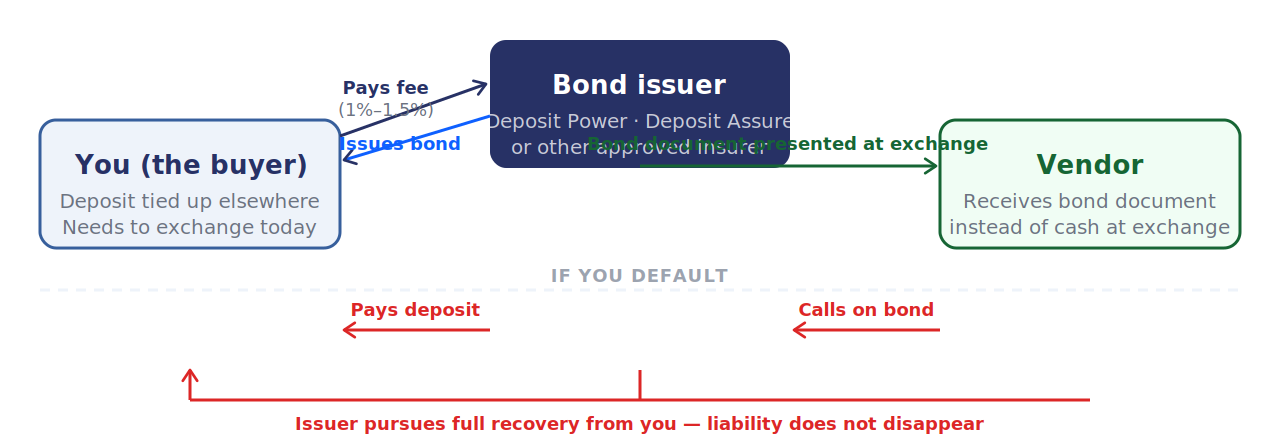
A deposit bond, also called a depository bond or deposit guarantee, is a written guarantee issued by an approved insurer that substitutes for a cash deposit at the point of exchange. Instead of handing over $60,000 in certified funds to the vendor’s agent when you sign the contract, you hand over a document from the insurer guaranteeing that the deposit amount will be paid if you fail to complete the purchase.
The vendor receives the same legal protection they would have from a cash deposit. You do not hand over any money at exchange. You pay a fee to the insurer for the guarantee which is typically a fraction of the deposit amount and the insurer takes on the risk of your default.
A deposit bond is not a loan and it is not insurance in the traditional sense. It is a contractual guarantee. The insurer is not lending you the deposit amount as they are guaranteeing it. If you default on the purchase and the vendor calls on the bond, the insurer pays the vendor and then has full rights of recovery against you. The money becomes your debt to the insurer, not a written-off insurance claim.
How does a deposit bond work?
The mechanics are straightforward. You apply to an approved issuer, typically a specialist deposit bond provider or a general insurer authorised to issue them, with evidence of your financial position and your unconditional finance approval. The issuer assesses your application, and if approved, issues a bond document in the deposit amount required for the purchase.
At exchange, you provide the bond document to the vendor’s solicitor or agent in place of the cash deposit. The vendor’s solicitor accepts it as a substitute for cash, and the contract proceeds to exchange. The bond remains in force until settlement, at which point you pay the full purchase price and the bond is discharged.
If you proceed to settlement as planned, nothing further happens. The issuer collected their fee and the guarantee was never called on.
If you default, meaning you do not settle the purchase, the vendor can call on the bond. The issuer pays the vendor the guaranteed amount. The issuer then pursues you for recovery of that amount. A bond that is called means you owe the full amount to the insurer on top of having lost the property. The financial exposure is the same as forfeiting a cash deposit but the counterparty has changed from the vendor to the insurer.
How much does a deposit bond cost?
The cost of a deposit bond is typically expressed as a percentage of the deposit amount, and varies by the term of the bond.
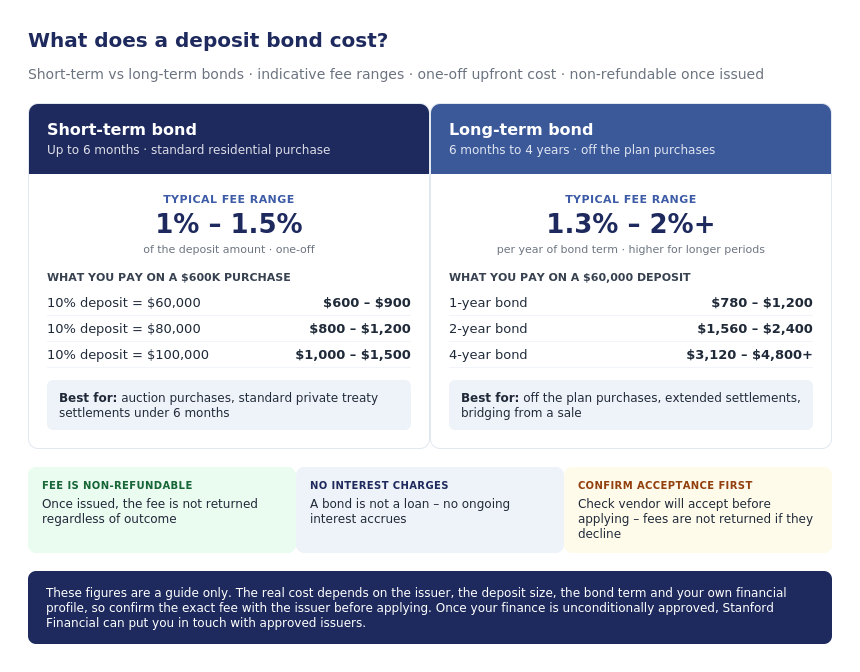
Short-term bonds (up to six months, covering most standard residential purchases) typically cost between 1% and 1.5% of the deposit amount. On a 10% deposit for a $600,000 property (a $60,000 deposit) a short-term bond would cost approximately $600 to $900. This is a one-off fee paid upfront to the issuer.
Long-term bonds (six months to four years, used for off the plan purchases and extended settlements) are priced higher, typically 1.3% to 2% or more of the deposit amount per year of the bond term. A two-year bond on a $60,000 deposit could cost $1,560 to $2,400 or more depending on the issuer and the term.
The major providers in Australia include Deposit Power and Deposit Assure, each with their own fee schedules and assessment criteria. Fees are non-refundable once the bond is issued, so it is important to confirm vendor acceptance before applying.
There are no ongoing fees or interest charges as the bond is a fixed-cost guarantee, not a loan facility.
Deposit bond vs cash deposit – which is right for you?
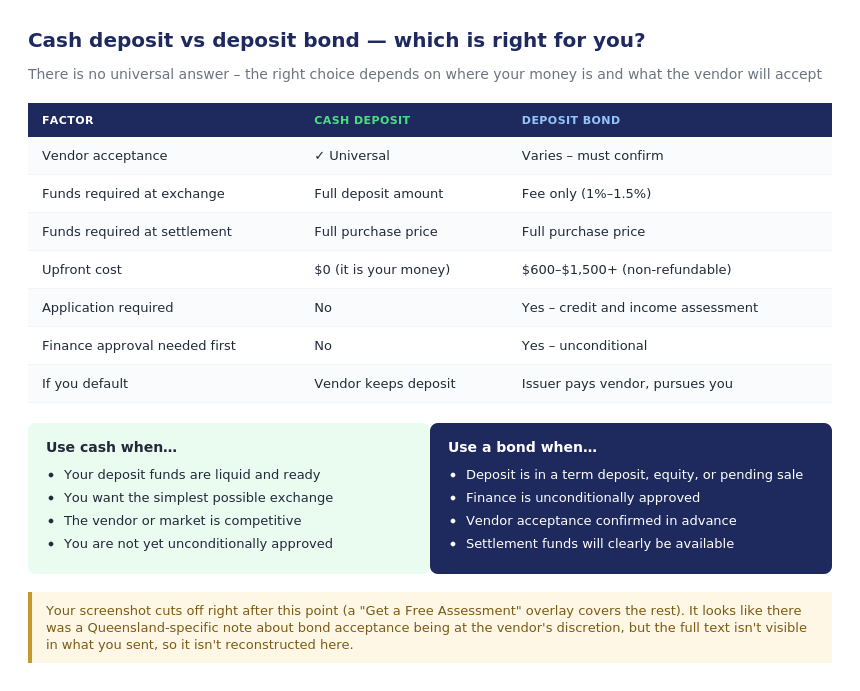
Whether a deposit bond or a cash deposit is appropriate depends on your specific situation. There is no universal answer.
A cash deposit is almost always preferable when your funds are accessible, the vendor has not indicated any restriction on bond acceptance, and you want the simplest possible exchange. Cash deposits are universally accepted, create no additional documentation requirements, and involve no ongoing guarantee risk. There is nothing to apply for, no assessment to pass, and no risk of the bond not being accepted on the day.
A deposit bond makes sense when your deposit funds are genuinely not accessible at exchange (tied up in a term deposit, in the equity of an unsold property, or awaiting a share sale settlement) and you have confirmed that the vendor will accept a bond. It is a practical solution to a genuine liquidity timing problem, not a way to purchase without having the funds at all. You still need to have the full deposit amount available by settlement.
Vendor acceptance is the critical variable in Queensland. Unlike some other states where deposit bonds are routinely accepted, Queensland vendors and their solicitors vary considerably in their willingness to accept bonds. In a multiple offer situation, a cash deposit will generally be preferred. You must confirm acceptance with the vendor’s agent before attending auction with a bond as finding out on the day that the vendor will not accept it is not a recoverable situation.
Who qualifies for a deposit bond?
Deposit bond issuers assess applications against their own criteria, but most require all of the following to be satisfied.
Unconditional finance approval. This is the most significant requirement and the one most commonly misunderstood. A pre-approval — sometimes called an approval in principle — is generally not sufficient for a deposit bond. Issuers typically require a fully assessed, unconditional loan approval from a lender, covering the specific property being purchased. This means the deposit bond process is usually initiated after finance has been formally approved, not before.
Sufficient equity or asset position. The issuer is taking on the risk of your default, so they will assess whether you have the net asset position to support recovery if the bond is called. Buyers with very limited equity or assets beyond the property being purchased may not qualify.
Clean credit history. Adverse credit (defaults, judgements, or discharged bankruptcies) will typically disqualify an application. Bond issuers are underwriting default risk, so credit assessment is part of the process.
Adequate funds for settlement. The issuer will want to confirm that you have a clear pathway to settlement funds whether through existing savings, the sale of a property, or a confirmed loan facility. A bond issued to a buyer who has no clear plan for settlement funds is not something a responsible issuer will provide.
Deposit bonds and your home loan
The relationship between a deposit bond and your home loan matters and is often misunderstood.
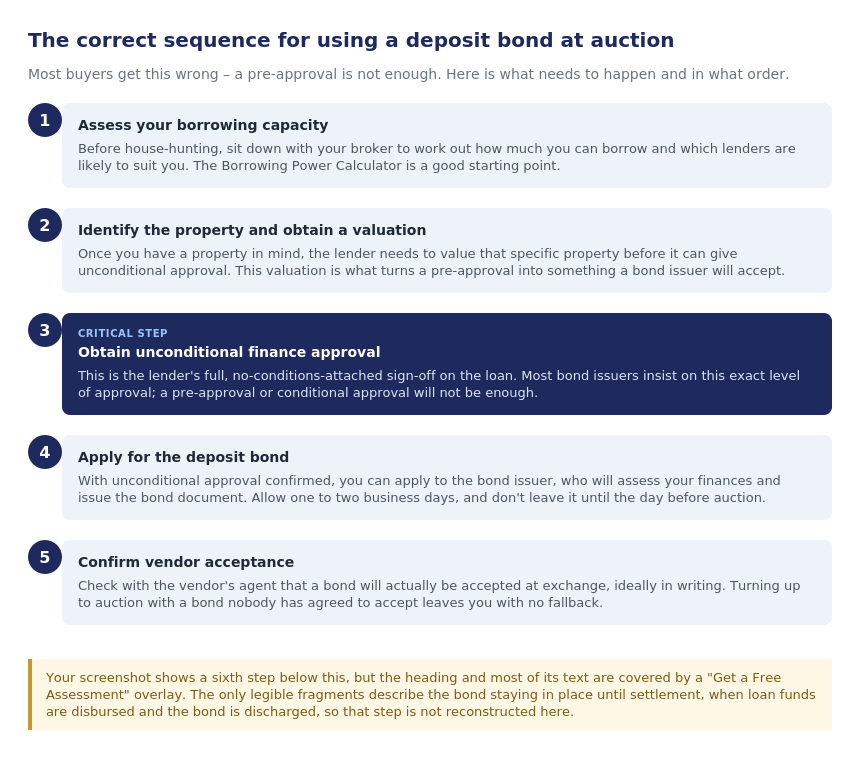
The deposit bond satisfies the contractual requirement for a deposit at exchange. It does not affect the structure of your home loan or the amount you are borrowing. At settlement, your lender disburses the loan funds in the normal way — the bond simply ensured the vendor was protected during the period between exchange and settlement.
However, the home loan must be unconditionally approved before most issuers will issue the bond. This means the correct sequence is: obtain unconditional finance approval from your lender, then apply for the deposit bond, then attend auction or exchange. Attempting to get a bond on the basis of a pre-approval alone will typically fail at the issuer’s assessment stage.
Your broker plays a critical role in this sequence. Getting to unconditional approval before your auction date requires a completed application, a fully assessed property valuation, and lender sign-off on all conditions. If you are planning to bid at auction with a deposit bond, your broker needs to know well in advance so the loan can be progressed to unconditional status in time.
Use the Borrowing Power Calculator to understand your position before starting the formal approval process.
When a deposit bond is not the right option
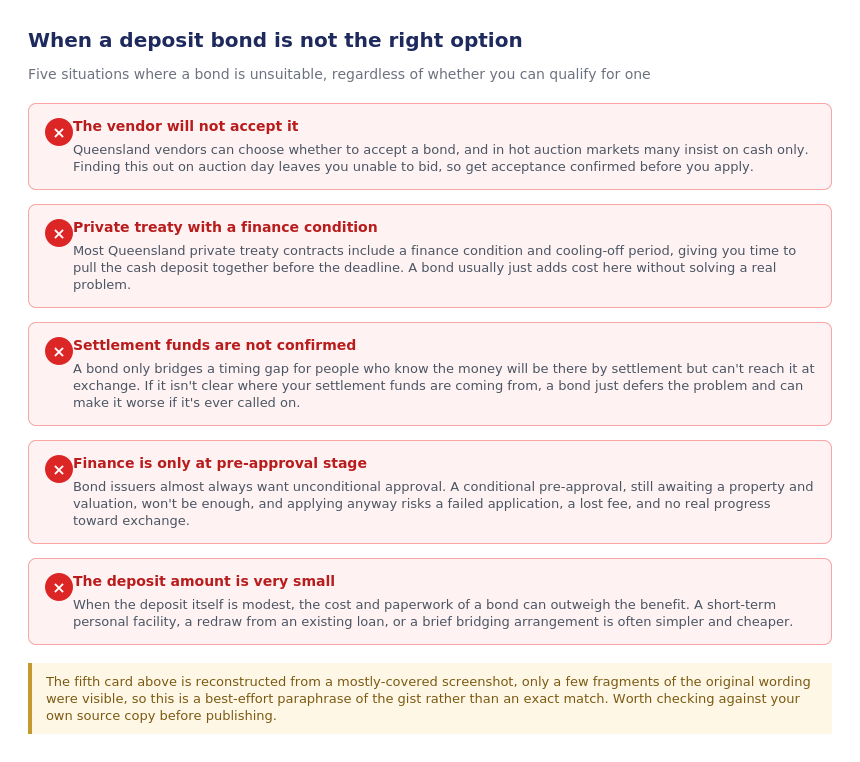
There are several situations in which a deposit bond is unsuitable regardless of whether you can qualify for one.
The vendor will not accept it. Vendor acceptance is not guaranteed in Queensland. If the vendor or their solicitor has specified cash only, as is increasingly common in competitive auction markets, a bond is not an option regardless of its validity. Always confirm acceptance before bidding.
Private treaty purchases with subject to finance clauses. Most private treaty residential purchases in Queensland include a finance condition. In this situation, there is usually time to arrange a cash deposit by the finance condition deadline, and the bond may be unnecessary. Bonds are most valuable in unconditional scenarios particularly auctions where there is no cooling-off period and no finance condition to rely on.
You do not yet have the settlement funds confirmed. A deposit bond is not a substitute for not having a deposit. It is a timing tool for people who will have the funds by settlement but cannot access them at exchange. If you are not certain that settlement funds will be available, a deposit bond merely defers the problem and potentially compounds it if the bond is called.
The deposit amount is very small. For smaller purchases where the 10% deposit is a modest sum, the cost and complexity of obtaining a bond may not be justified compared to simply arranging a short-term personal facility or redraw from an existing loan.
Queensland-specific note. Queensland uses standard REIQ contracts, which specify that the deposit is payable at exchange. Bond acceptance is at the vendor’s discretion and is not mandated by the contract form. In some other states, bond acceptance is more standardised but in Queensland, you are always subject to the vendor’s position. This is a meaningful practical distinction for Queensland buyers compared to buyers in New South Wales or Victoria.
How Stanford Financial can help
A deposit bond is only useful if your finance is in order first. The foundation of any successful auction purchase — bond or cash — is having your borrowing capacity confirmed and your loan progressed to the strongest possible approval before you bid.
Stanford Financial works with buyers across the pre-auction preparation process. We assess your borrowing capacity, identify the right lenders for your situation, and progress your application toward unconditional approval so you have the clearest possible position before auction day. We work with clients who need a deposit bond by ensuring the unconditional approval the bond issuer requires is in place, and we can refer you directly to approved bond issuers once that approval is secured.
For buyers purchasing before their current property sells, we can also model the bridging finance options alongside the deposit bond to help you understand the full picture of costs and risks before committing.
If you are planning to bid at auction in the next 30 to 60 days and your deposit is not sitting liquid and ready, the time to call is now (not the week before).
Frequently asked questions
- What is a deposit bond?
A deposit bond is a written guarantee issued by an approved insurer that substitutes for a cash deposit at the point of exchange on a property purchase. It allows you to satisfy the deposit requirement without providing cash on the day. You pay a fee for the bond, not the deposit amount itself. If you default and the vendor calls on the bond, the insurer pays the vendor and then pursues you for recovery of the full amount.
- How much does a deposit bond cost in Australia?
Short-term deposit bonds (up to six months) typically cost between 1% and 1.5% of the deposit amount. On a $60,000 deposit that is $600 to $900. Long-term bonds for off the plan purchases cost more, typically 1.3% to 2% per year of the bond term. Fees are paid upfront and are non-refundable once the bond is issued.
- Do I need unconditional finance approval to get a deposit bond?
Yes, in most cases. Deposit bond issuers generally require a fully assessed, unconditional loan approval from a lender (not just a pre-approval). This means the deposit bond application is typically made after your finance has been formally approved for the specific property being purchased.
- Will Queensland vendors accept a deposit bond?
Not always. In Queensland, vendor acceptance of a deposit bond is at the vendor’s discretion and is not mandated by the standard REIQ contract. You must confirm that the vendor will accept a bond before attending auction or proceeding to exchange. In competitive markets, many vendors prefer cash deposits.
- Does a deposit bond replace the deposit at settlement?
No. A deposit bond satisfies the deposit requirement at exchange only. At settlement, you are still required to pay the full purchase price including the deposit amount. The bond is discharged at settlement once the full funds are received by the vendor.
- Can I use a deposit bond if I am buying off the plan?
Yes, deposit bonds are commonly used for off the plan purchases where exchange occurs well before settlement. Long-term bonds can be issued for periods of up to four years, covering the full gap between exchange and settlement. The cost is higher for longer-term bonds
- What happens if I default and the deposit bond is called?
If you default and the vendor calls on the bond, the issuer pays the vendor the guaranteed deposit amount. The issuer then has full rights of recovery against you for that amount. You remain financially liable for the full deposit — the bond changes the counterparty from the vendor to the insurer, but does not eliminate your liability.
- Can I get a deposit bond with a pre-approval only?
Generally no. Most issuers require unconditional finance approval, meaning the lender has formally assessed the specific property and approved the loan without conditions outstanding. A pre-approval alone is usually insufficient because it is conditional on the property being accepted as security, which has not happened at the pre-approval stage.
- Is a deposit bond the same as a bank guarantee?
Not exactly. Both substitute for a cash deposit but they are issued by different parties under different arrangements. A bank guarantee is issued by a bank, often requiring you to put up cash or security as collateral. A deposit bond is issued by an insurer based on an assessment of your financial position and does not require collateral. For residential property purchases, deposit bonds are the more commonly used instrument.